Vyborn: Building a Full-Stack E-Commerce Experience with Next.js 15 and Supabase
An inside look at how I engineered Vyborn, a headless e-commerce store with Supabase SSR Auth, Prisma with PostgreSQL, and GSAP animations.
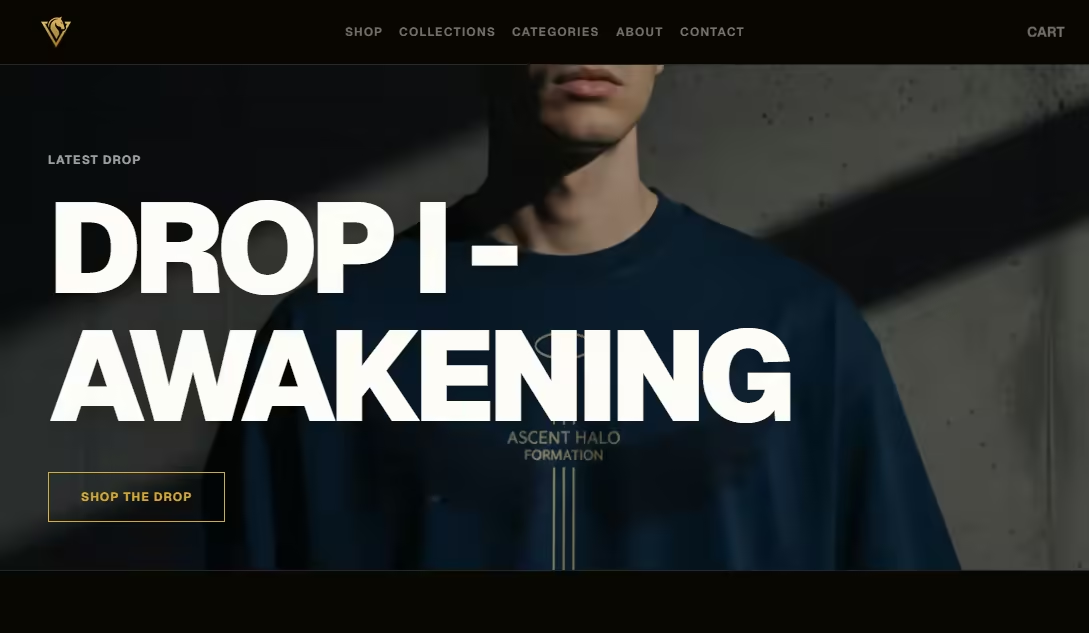
E-commerce is one of the most demanding spaces for web development. A store must be blazing fast to prevent bounce rates, highly secure to handle user data, and visually stunning to build brand trust.
For Vyborn, my latest e-commerce project, I opted for a modern, highly scalable stack using Next.js 15, Supabase, and Prisma ORM. Here is a technical breakdown of how the pieces fit together.
1. Robust Authentication with Supabase SSR
Relying on client-side authentication can lead to jarring loading states or flashes of unauthenticated content. To solve this, Vyborn uses @supabase/ssr to handle sessions securely via cookies.
By lifting the authentication logic completely to the server (using Next.js Middleware and Server Components), the storefront cleanly determines a user's session before a single byte of HTML is painted to the browser.
// Example: Checking authentications via Supabase on the Server
import { createClient } from '@/lib/supabase/server'
import { redirect } from 'next/navigation'

export default async function AccountPage() {
  const supabase = createClient()
  const { data: { user } } = await supabase.auth.getUser()

  if (!user) return redirect('/login')

  return <Dashboard user={user} />
}
2. Type-Safe Data Modeling with Prisma & PostgreSQL
For the catalog and order tracking, I paired a PostgreSQL database with Prisma ORM.
Having a strict schema makes relationships between Users, Orders, and Products completely bulletproof. The database structure ensures referential integrity, while Prisma's typed client enables me to catch database queries that could fail directly inside my IDE before it ever hits production.
3. Separation of Concerns: Storefront vs Admin
To keep the application highly organized, I utilized Next.js Route Groups.
app/(store)encapsulates all client-facing routes like product listings, cart management, and checkout.app/(admin)handles an entirely separate layout and dashboard for managing inventory, powered by custom components likereact-dropzonefor secure image uploads.
4. Fluid Interactions with GSAP and Zustand
You can't have a modern portfolio piece without premium interactions. Instead of standard CSS transitions, Vyborn leverages @gsap/react and custom components like ScrollReveal and StaggeredMenu.
Meanwhile, I chose Zustand for client-side state. E-commerce requires complex global cart states that need to be accessible from navigation bars, product pages, and checkout drawers. Zustand provides this capability without the massive boilerplate of Redux or the performance-rendering traps of standard React Context.
The Result
The result is an end-to-end commerce template that feels inherently fluid, resolves data instantly via Server Components, and is entirely type-safe from the database to the DOM.